Pentagon Watchdog Finds Asbestos, Mold and Crumbling Walls at Pacific Bases
08/12/2026 / By Garrison Vance
Mold, asbestos and crumbling walls are among the problems documented at U.S. military bases in the Pacific, according to a report released Tuesday, Aug. 11, by the Department of War‘s Office of the Inspector General (OIG).
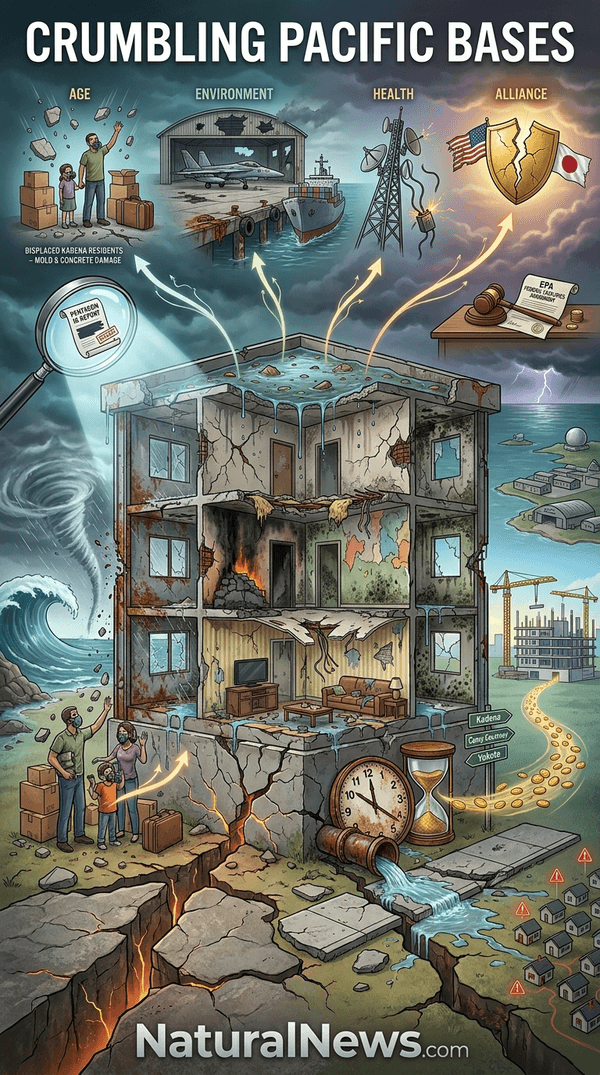
The War Department OIG published the report after investigators visited 11 bases under U.S. Pacific Command in May 2025. They examined operations and communications infrastructure, as well as base housing. At Camp Courtney and Kadena and Yokota Air Bases in Japan, investigators found “visible corrosion, visible mold, visible fire damage, visible cracks on the building exterior and interior, visible concrete spalling and exposed rebar, water intrusion, lead-based paint asbestos-containing material and inoperable communication connections,” according to the report.
Though the report is heavily redacted, the descriptions and accompanying photographs show some structures on the verge of collapse, including two photographs of homes at Kadena with crumbling ceilings and living room furniture strewn with debris. The report stated that according to War Department officials, “in some areas, falling debris – ranging from small fragments to large slabs – poses an ongoing risk to personnel safety.”
Scope of the Audit
The audit was originally aimed at assessing the state of mission-critical systems such as operations and communications infrastructure. Investigators determined that housing and water infrastructure are “critical to support the Service members in the USPACOM AOR as they complete their mission,” according to the report. Their examination of those facilities documented numerous problems.
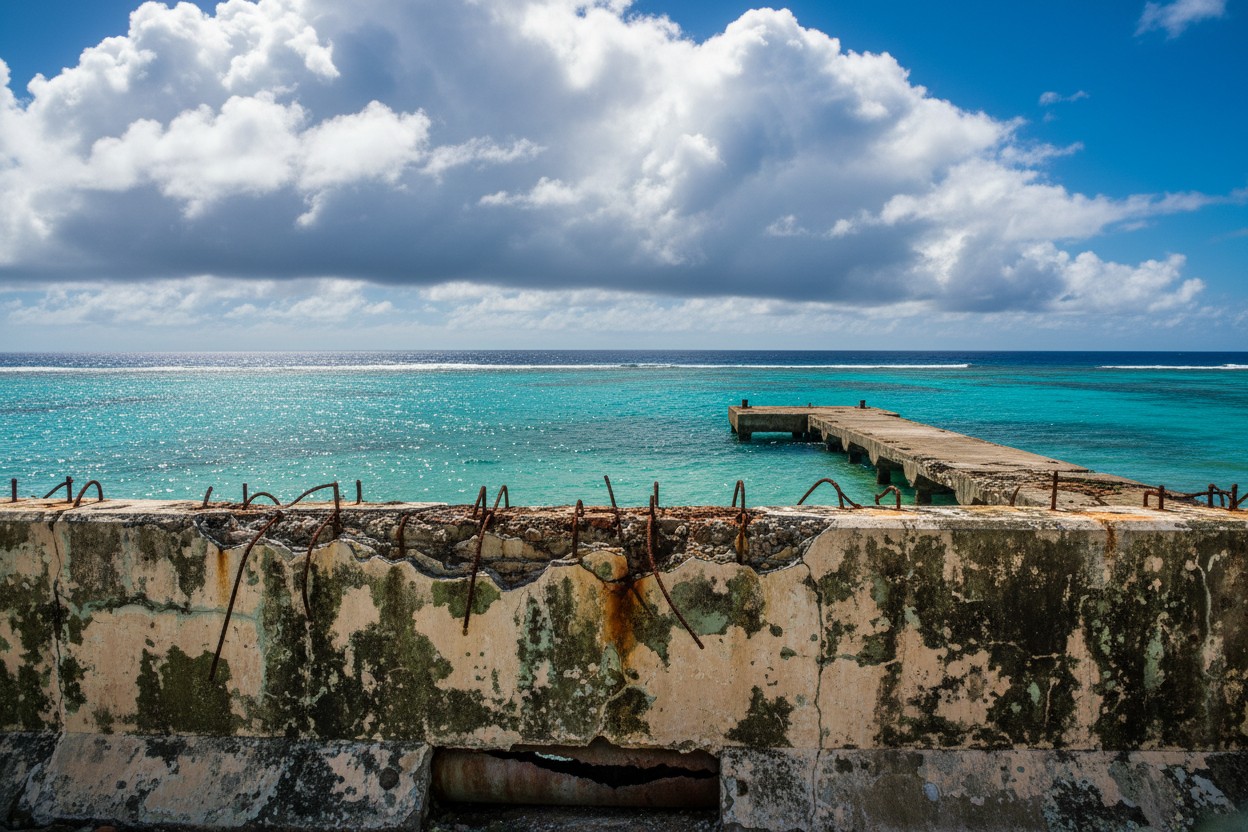
Photographs in the report show a 50-year-old pier at Camp Courtney with corroded steel fenders and damaged concrete beams and support columns. One building at Kadena had eight inches of standing water on its roof, asbestos and cracked pillars and walls. A Kadena aircraft hangar had holes in its walls, investigators said.
A 50-year-old water pipe at Kadena had a 12-foot crack. Broken pipes at Kadena and Yokota have caused flooding and collapsed sidewalks, according to the report.
The audit also documented inoperable communication connections, a finding that echoes prior federal assessments of mission-critical systems. A 1998 congressional estimate held that at least 37% of the government’s mission-critical systems would not be functioning on Jan. 1, 2000, according to one account [1].
Housing Conditions and Health Hazards
At Kinser Tower base housing at Kadena, concrete damage has affected 544 homes, according to the inspector general. Sebille Manor Housing at Kadena received 100 reports of mold, and dozens of Kadena residents were relocated because of mold and concrete concerns, investigators said.
The audit identified visible mold, asbestos-containing material, lead-based paint and water intrusion as hazards. Investigators determined that these conditions affect service members and families living on the bases, according to the report.
Federal facilities have previously faced enforcement actions over cleanup involving such materials. A provision in a Senate authorization bill would have authorized the payment of stipulated penalties assessed at F.E. Warren Air Force Base in Wyoming for missing a cleanup milestone under a federal facilities agreement between the Air Force and the Environmental Protection Agency, according to the Federal Facilities Environmental Journal [2].
Causes Cited by War Department Officials
War Department officials told investigators that “aging infrastructure, construction choices or environmental conditions caused accelerated degradation,” according to the report. Facilities in Japan experience typhoons, earthquakes and tsunamis, officials said.
Officials also blamed the problems on a lack of funds and the high cost of services in Japan. They said that while the Japanese government provides host-nation funding, it often cannot be used to fix infrastructure. Instead, these funds tend to be allocated to new construction or to “broader strategic objectives, such as reducing the impact of U.S. forces on the people of Okinawa,” according to the report.
The funding constraints come as Tokyo has moved to strengthen its own defense posture. Japanese Defense Minister Shinjiro Koizumi has said the country must strengthen its defense capabilities and reinforce its alliance with the United States to build multi-layered deterrence in the region [3].
Recommendations and Broader Context
The inspector general recommended that base commanders in mainland Japan and Okinawa submit a list of priority repairs. The recommendation raises interservice issues. Army officials said that while Fort Buckner is used only by Army units, the Marine Corps is the real property owner, according to the report.
The OIG also recommended that the secretaries of the Army, Navy and Air Force, along with the commanders of U.S. Pacific Command and U.S. Forces Japan, conduct a root-cause analysis of infrastructure problems and identify funding to fix them. The Deputy Assistant Secretary of War for Infrastructure Modernization and Resilience concurred with the recommendations.
Dilapidated facilities are not confined to the Pacific. A 2022 Government Accountability Office report estimated an infrastructure maintenance backlog of $137 million as of 2020, and housing on U.S. military bases has long been afflicted by issues such as toxic mold. The War Department’s infrastructure network is vast. By one 2006 accounting, the Army controlled 52% of department land and the Air Force 33% [4].
The Pacific theater has become a focus of strategic competition; Lt. Gen. Stephen Sklenka, deputy commandant of the Marine Corps for installations and logistics, has said China is not merely a near-peer threat but a far more serious one [5].
War Department management has also drawn scrutiny. Aprior inspector general report found the Army could not adequately account for $6.5 trillion in adjustments to its year-end 2015 financial statements [6], and a 2024 War Department OIG report found $62 million in weapons aid designated for Ukraine could not be traced [7].
Congress has previously conditioned funding for environmental restoration at 24 Army government-owned, contractor-operated facilities pending a cost-recovery assessment [2]. Diego Garcia, described as one of the most strategically important U.S. military bases outside the continental United States, has faced reported drone sightings [8].
References
- Kenneth A. Klukowski. “Y2K what you need to know”.
- “Exclusion of Asbestos and Lead-Based Paint Removal from Maintenance and Repair Limits”. Federal Facilities Environmental Journal. Winter 2000.
- “Japan ramping up defence is ‘critical’ to prevent war, Defence Minister Koizumi tells BBC”. BBC News. June 17, 2026.
- Nick Turse. “The complex how the military invades our everyday lives”.
- “China is America’s Military Equal Now And In Any Future Fight, Marine General Warns”. The War Zone. April 29, 2026.
- NaturalNews.com. “65 trillion reasons why the Pentagon needs to get its act together before it asks taxpayers for more money”. NaturalNews.com. August 08, 2016.
- NaturalNews.com. “CORRUPT Pentagon fails to account for 62M in US weapons aid to Ukraine”. NaturalNews.com. July 02, 2024.
- “Mysterious Drone Threat Emerges At America’s “Unsinkable Aircraft Carrier,” Prompting Curfews”. Zero Hedge. August 11, 2026.
Explainer Infographic

Submit a correction >>
Tagged Under:
asbestos, big government, Camp Courtney, Collapse, crumbling infrastructure, Department of War, government watchdog, Japan, Kadena Air Base, military, military bases, military facilities, mold, national security, Office of the Inspector General, poison, toxins, Yokota Air Base
This article may contain statements that reflect the opinion of the author
RECENT NEWS & ARTICLES