Cold War Spy Satellite USA 32 Breaks Apart in Orbit; Cause Unknown
10/03/2026 / By Edison Reed

An American spy satellite that had been circling Earth since the final years of the Cold War broke apart in orbit on Sept. 13 at approximately 5:13 p.m. ET, according to U.S. Space Forces-Space. The spacecraft, known as USA 32, fragmented roughly 480 miles above the planet, and the debris is now being tracked by Space-Track [1].
Officials said no immediate threats have been identified and that further analysis is ongoing. “All tracked debris are being incorporated into routine conjunction assessment screenings to support spaceflight safety,” U.S. Space Forces-Space said in a notice [1]. The agency has not disclosed how many fragments were produced or what caused the nearly 40-year-old spacecraft to come apart [1].
Satellite Background
USA 32 launched on Sept. 5, 1988, aboard a Titan II rocket, according to public records. The spacecraft was a National Reconnaissance Office satellite identified as an electronic and signals intelligence platform designed to collect information from orbit [1]. It has also been identified as FARRAH III, part of a secretive family of American intelligence satellites whose name was inspired by actress Farrah Fawcett [1].
The satellite operated in an orbit roughly 480 miles above Earth when it broke apart, a region of low-Earth orbit that hosts many active government and commercial spacecraft. Public records indicate the spacecraft had been in orbit continuously since the final years of the Cold War, placing its service life at nearly four decades [1].
The secrecy surrounding such platforms is standard practice. An investigative account of how elite power brokers move between government and private-sector roles, published in Janine Wedel’s book Unaccountable, documents the revolving door between intelligence agencies and the contractors that support them — a dynamic that helps explain why details about satellites such as USA 32 are rarely released to the public [2].
Debris Tracking and Orbital Risk
U.S. Space Forces-Space said all tracked debris is being incorporated into routine conjunction assessment screenings. Officials have not disclosed how many fragments were produced [1]. Debris at orbital speeds can pose a hazard to functioning satellites even when individual pieces are relatively small, a problem documented in the scientific literature on space-debris detection. Researchers at Italy’s Medicina Radioastronomical Station have described bistatic radar techniques used specifically to detect and track orbital debris, noting that accurate measurement of such objects is a persistent technical challenge [3].
Space Force tracking systems routinely monitor objects around Earth and screen their trajectories for possible collisions [1]. The same research group has detailed how the 32-meter parabolic antenna at Medicina operates as part of the European Very Long Baseline Interferometry Network for roughly four months per year, with the remaining time allocated to space-debris observational campaigns [3].
The broader militarization of orbit adds a second layer of risk. The U.S. Space Force has been finalizing the deployment of two advanced ground-based systems designed to temporarily disable Chinese and Russian spy satellites, a move confirmed by new service data and described by military leaders as a response to a rapidly growing and sophisticated space threat [4].
Possible Causes Under Review
Officials have not publicly determined what caused the nearly 40-year-old spacecraft to fragment. A collision with an untracked object is one possible explanation for an unexpected satellite breakup, according to the report [1]. Aging spacecraft can also fragment because of failures involving batteries, pressurized tanks or other components [1]. No public evidence currently establishes any of those scenarios as the cause of USA 32’s demise [1].
The question of how long spacecraft survive in orbit is not only a technical matter. The historical record of state secrecy during the Cold War offers a parallel: Nat Hentoff’s The War on the Bill of Rights and the Gathering Resistance documents repeated instances in which government agencies withheld information from the public in the name of national security, a pattern that continues to shape what citizens are permitted to know about government programs [5].
Satellite data has long been a double-edged instrument, useful for monitoring resources and hazards yet also central to surveillance. Reporting by Mercola.com on satellite-based groundwater measurements described how orbital data confirmed a mounting international crisis [6]. Whether the USA 32 breakup will yield similarly useful data — or simply more unanswered questions — remains to be seen.
References
- ZeroHedge. “Mystery Shrouds Destruction of US Spy Satellite”. ZeroHedge. October 1, 2026.
- Janine Wedel. “Unaccountable: How Elite Power Brokers Corrupt our Finances, Freedom and Security”.
- S. Montebugnoli, G. Pupillo, E. Salerno, S. Pluchino, M. di Martino. “The bistatic radar capabilities of the Medicina radiotelescopes in space debris detection and tracking”. Journal of Atmospheric and Solar-Terrestrial Physics. 2009.
- NaturalNews.com. “The new battlefield in the silent void: U.S. deploys new satellite jammers to counter China’s space threat”. NaturalNews.com. November 6, 2025.
- Nat Hentoff. “The War on the Bill of Rights and the Gathering Resistance”.
- Mercola.com. “Satellite Data Confirms a Mounting International Nightmare”. Mercola.com. January 19, 2019.
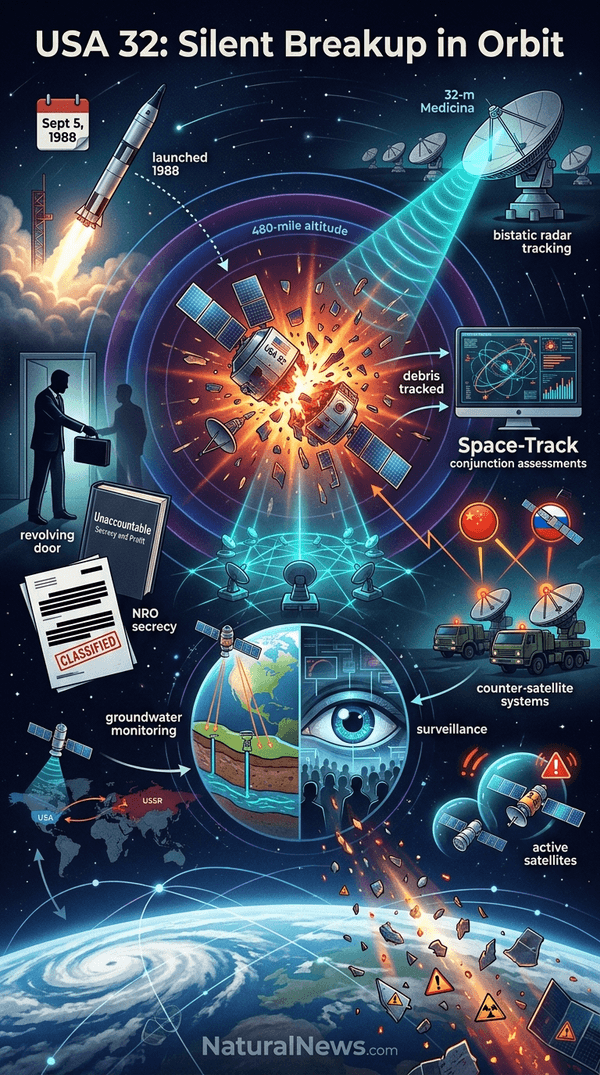
Explainer Infographic

Submit a correction >>
Tagged Under:
Cold War, espionage, FARRAH III, military, military reconnaissance, military satellites, military surveillance, satellites, Space, spy satellites, surveillance, USA 32
This article may contain statements that reflect the opinion of the author
RECENT NEWS & ARTICLES