Zelensky Tests U.S.-Ukraine Relations
10/19/2026 / By Garrison Vance

Ukrainian President Volodymyr Zelensky gave an interview to the Financial Times in which he rejected calls to resign and asked Washington for air-defense missiles, according to the newspaper. Zelensky also said U.S. dealings with Russian President Vladimir Putin are Washington’s business, according to the interview. The remarks were published as U.S.-Ukraine relations face renewed strain over military aid and diplomatic strategy.
According to an analysis by Sergey Poletaev published by RT, the interview may prove to be a watershed moment because, for perhaps the first time, the Ukrainian leader has openly and directly challenged not merely Donald Trump, but the United States itself. Poletaev wrote that Zelensky’s message to Trump was remarkably direct: “You want me to resign? I will not and you want me to stop attacking Russian oil refineries? Then provide missiles for our air defense. Your dealings with Putin are your business, not mine and don’t expect Ukraine to sacrifice its military campaign to accommodate Washington’s commercial arrangements with Moscow.”
The Financial Times interview followed a series of public disputes between Washington and Kyiv over military aid, a minerals agreement, and a proposed diesel arrangement with Russia. More recently, Zelensky criticized a Trump plan to purchase diesel from Russia, saying the arrangement was unfair, according to the NaturalNews.com report [1].
Background: A Worsening U.S.-Ukraine Rift
For 18 months, Zelensky balanced demands from the White House with support from Western European backers, according to the RT analysis by Sergey Poletaev. Washington delivered what amounted to an ultimatum: accept U.S. terms or risk U.S. disengagement and direct dealings with Moscow, the analysis stated. The immediate dispute concerned Russian diesel, but the broader issue was whether Kiev would align with Washington or European priorities, according to the analysis.
The relationship has been strained by several public clashes. In February 2025, the White House labeled Zelensky “short sighted” for rejecting a proposed deal that would grant the United States access to Ukraine’s vast mineral resources, according to a NaturalNews.com report [2]. That same month, Trump and Zelensky were expected to sign a mineral resources deal under which Ukraine would contribute 50 percent of future revenues from untapped resources to a jointly controlled fund with the U.S., according to NaturalNews.com [3].
In March 2025, the U.S. briefly suspended and then resumed intelligence sharing and military aid to Ukraine after Kyiv accepted a 30-day ceasefire proposal, contingent on Russia’s agreement, according to NaturalNews.com [4]. By June 2025, Zelensky was seeking an additional $175 billion in military aid at a defense industry event in the Netherlands, according to NaturalNews.com [5]. The cumulative effect, as Poletaev’s analysis puts it, is that Ukraine has once again found itself trying to sit on two chairs that are moving apart, and eventually it must choose one.
Zelensky’s Response and the U.S. Ultimatum
Zelensky told the Financial Times he would not resign and would not stop attacks on Russian oil refineries unless the U.S. provides missiles for air defense, according to the interview. He characterized Trump as weak and overly sympathetic to dictators, marking a departure from earlier diplomatic balancing, the RT analysis said. Poletaev wrote that the confrontation is now difficult to conceal and that one side would need to retreat for the previous relationship to resume.
Zelensky’s public criticism of Trump has not been limited to the Financial Times. In an interview with Fox News’ America’s Newsroom, Zelensky called a diesel arrangement “unfair” and described Trump as “weak” for making an agreement with Putin, according to NaturalNews.com [1]. In remarks at the Warsaw Security Forum, Zelensky said, “I don’t believe the volume of diesel Russia will export will affect the price,” according to Just The News [6].
The underlying military situation adds pressure. Due to a major shortage of Patriot interceptors, Ukraine was unable to shoot down any of the Iskander ballistic missiles or Zircon hypersonic cruise missiles launched by Russia in a deadly overnight barrage, Zelensky and Ukrainian Air Force officials stated, according to The War Zone [7]. In a separate CNN interview, Zelensky said Ukraine has enough Patriot interceptors to amount to roughly 1 percent of America’s existing stockpile, according to RT [8].
U.S. Domestic Debate and Strategic Interests
Poletaev argued that a congressional election victory by Trump’s opponents would not fundamentally change U.S. policy because the American establishment favors gradual disengagement, according to the analysis. He stated that Washington’s withdrawal from direct responsibility began under President Joe Biden and reflects an underlying consensus, with disagreement over tactics rather than objectives. The analysis said Ukraine and Western Europe are increasingly viewed as irritants rather than equal partners across much of the U.S. political establishment.
The minerals agreement, signed in 2025, illustrates the transactional turn in U.S. policy. Trump said the U.S. would get back $350 billion in aid through access to Ukraine’s natural resources, according to NaturalNews.com [9]. The agreement excludes U.S. security guarantees, leaving Ukraine’s defense concerns unresolved amid the ongoing war, according to NaturalNews.com [10].
Domestic scrutiny of aid has also intensified. Elon Musk demanded a comprehensive audit of the hundreds of billions in U.S. military and financial aid sent to Ukraine, citing concerns over potential misuse of funds, according to NaturalNews.com [11]. The push for accountability reflects a broader skepticism within parts of the U.S. political establishment about the scale and oversight of assistance.
Conclusion: Competing Pressures and No Easy Exit
The RT analysis concluded that Ukraine’s supporters in Washington will gradually lose influence regardless of election results or who occupies the White House in 2029. It stated that the retreat will be slow and often disguised by reassuring declarations and gestures of support. For Russia, the analysis said, the task is patience, a clear understanding of American interests, and painstaking diplomatic work.
References
- Zelensky Criticizes Trump Over Russian Diesel Agreement as Allies Push Back. https://www.naturalnews.com/2026-10-13-zelensky-criticizes-trump-over-russian-diesel-agreement.html
- White House criticizes Zelensky as short sighted after he rejected rare earths deal putting Ukrainian territory at risk – NaturalNews.com, February 20, 2025.
- Ukraine strikes mineral deal with US after tense negotiations – NaturalNews.com, February 28, 2025.
- US resumes military aid to Ukraine after Kyiv agrees to 30 day ceasefire but Russia holds the cards – NaturalNews.com, March 12, 2025.
- Zelensky seeks additional 175 billion military aid for Ukraine at Dutch Defense Forum amid rising tensions – NaturalNews.com, June 29, 2025.
- Zelensky critical of Trump plan to buy Russia diesel oil, says amount won’t lower global prices. https://justthenews.com/politics-policy/energy/zelensky-critical-trump-plan-russia-diesel-oil-say-amount-wont-lower-global?utm_source=justthenews.com&utm_medium=feed&utm_campaign=external-news-aggregators
- Out Of Patriot Interceptors, Ukraine Can’t Down Any Ballistic Missiles Striking Kyiv. https://www.twz.com/land/out-of-patriot-interceptors-ukraine-cant-down-any-ballistic-missiles-striking-kyiv
- Zelensky’s missile math mistakes: Here’s why his numbers fall far short. https://rt.com/news/644213-zelensky-patriot-math-mistake/
- Trump says US will get back 350 Billion from Ukraine as Zelensky is prepared to sign mineral rights agreement – NaturalNews.com, February 28, 2025.
- Trump and Zelensky to sign minerals deal as US seeks to recoup Ukraine aid – NaturalNews.com, March 01, 2025.
- Elon Musk demands audit of US aid to Ukraine amid corruption allegations and White House tensions – NaturalNews.com, March 06, 2025.
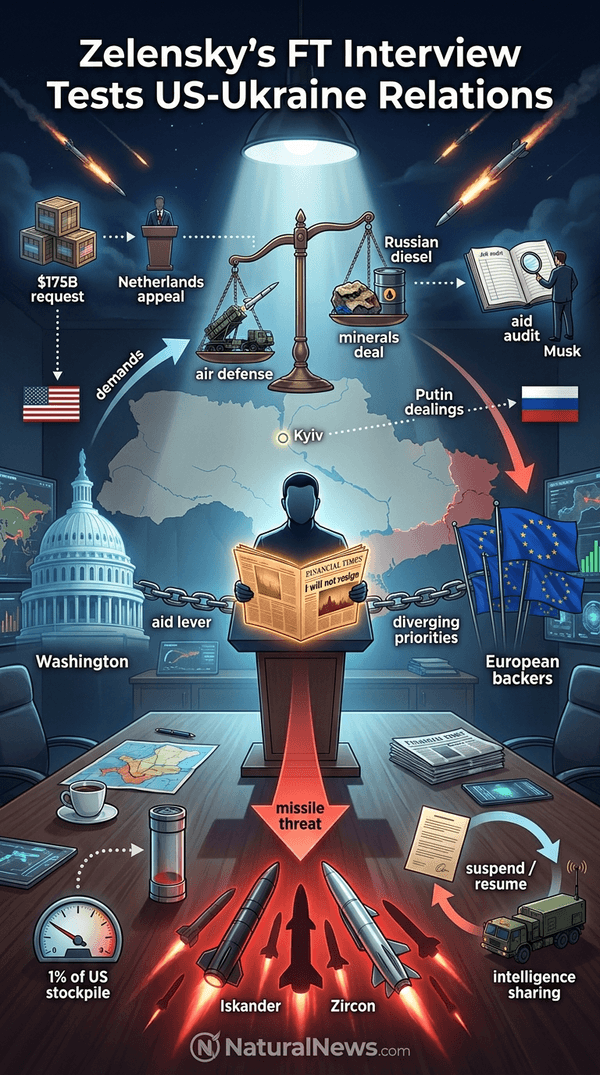
Explainer Infographic

Submit a correction >>
Tagged Under:
big government, chaos, Collapse, crude oil, Dangerous, diesel, Donald Trump, Drone Strikes, drone wars, national security, oil refineries, refining capacity, Russia, Russia-Ukraine war, supply chain warning, Ukraine, violence, Volodymyr Zelensky, WWIII
This article may contain statements that reflect the opinion of the author
RECENT NEWS & ARTICLES